 d708def38f
filepath.Base is platform-dependent for a bare volume name: on Windows it
strips the "C:" specifier and returns "\", so every drive letter
normalizes to the same key. findIoDevice's exact match then returns
whichever disk.IOCounters entry the map yielded first, which registers the
root filesystem under a random drive. With EXTRA_FILESYSTEMS=D:,P: the
root disk disappears from the hub, and without it the root can be
registered under another drive's I/O device.

Normalize a bare volume specifier before taking a path base, and stop
taking a path base of the device in addPartitionRootFs, where it mangled
the value before findIoDevice could see it. registerFilesystemStats
already avoided this by only taking a base when the agent is not on
Windows.

Fixes #2417
Beszel
Beszel is a lightweight server monitoring platform that includes Docker statistics, historical data, and alert functions.
It has a friendly web interface, simple configuration, and is ready to use out of the box. It supports automatic backup, multi-user, OAuth authentication, and API access.




Features
- Lightweight: Smaller and less resource-intensive than leading solutions.
- Simple: Easy setup with little manual configuration required.
- Alerts: Configurable alerts for most metrics. Supports many notification services.
- Docker stats: Tracks CPU, memory, and network usage history for each container.
- Network monitoring: Monitor response time and interruptions directly from agents.
- S.M.A.R.T.: Disk health data and notifications on drive failure.
- Multi-user: Users manage their own systems. Admins can share systems across users.
- OAuth / OIDC: Supports many OAuth2 providers. Password auth can be disabled.
- Automatic backups: Save to and restore from disk or S3-compatible storage.
Architecture
Beszel consists of two main components: the hub and the agent.
- Hub: A web application built on PocketBase that provides a dashboard for viewing and managing connected systems.
- Agent: Runs on each system you want to monitor and communicates system metrics to the hub.
Getting started
The quick start guide and other documentation is available on our website, beszel.dev. You'll be up and running in a few minutes.
Screenshots
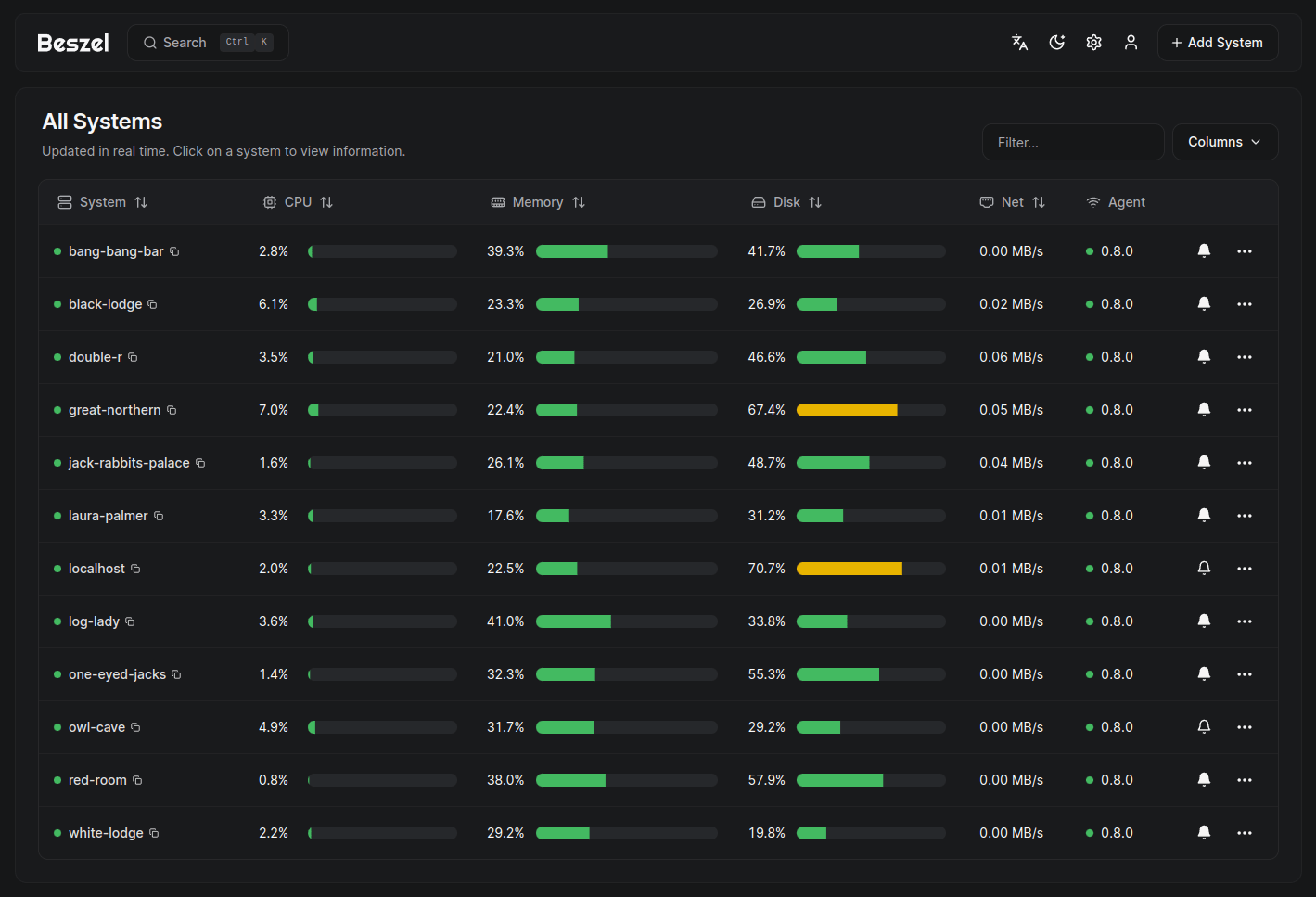
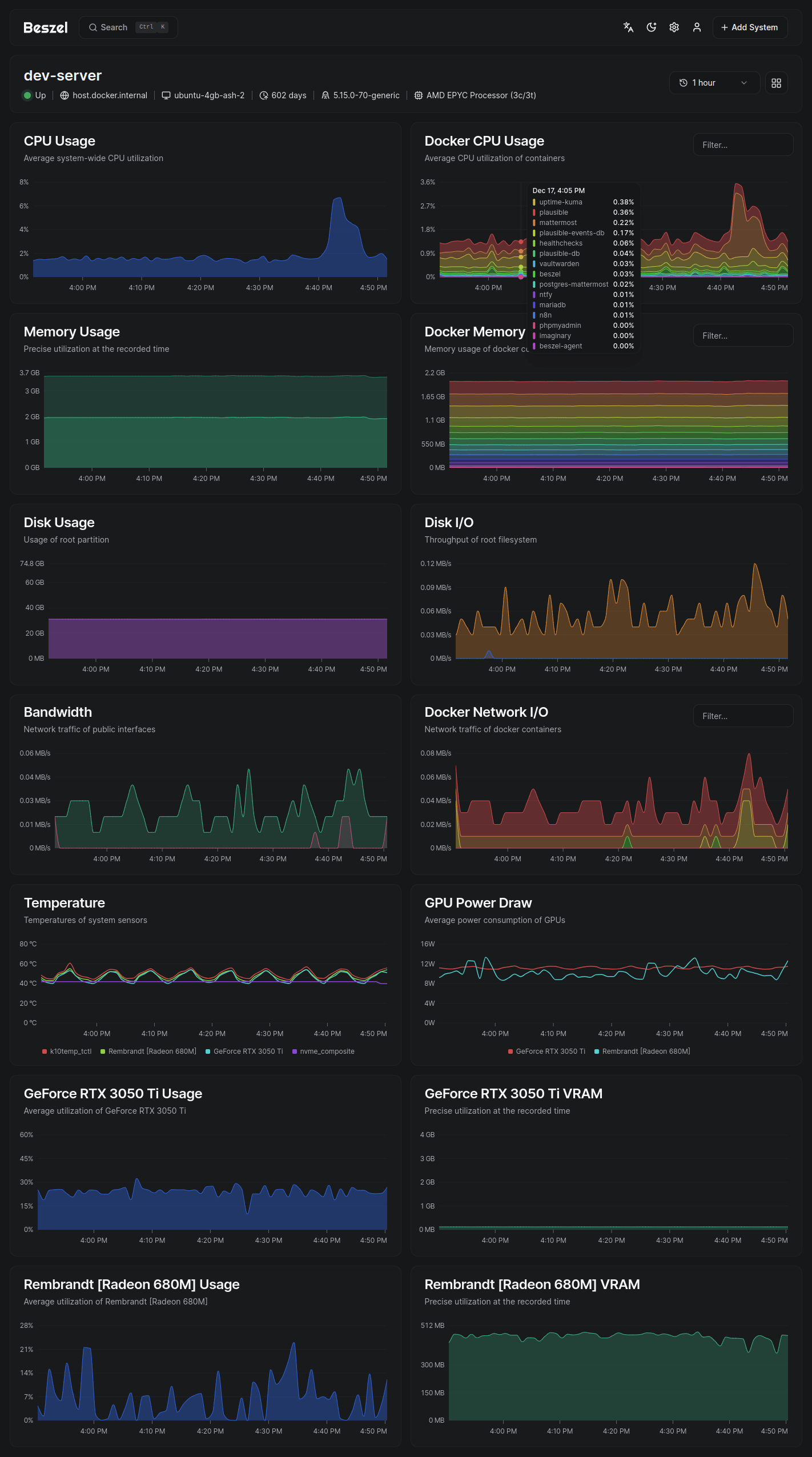
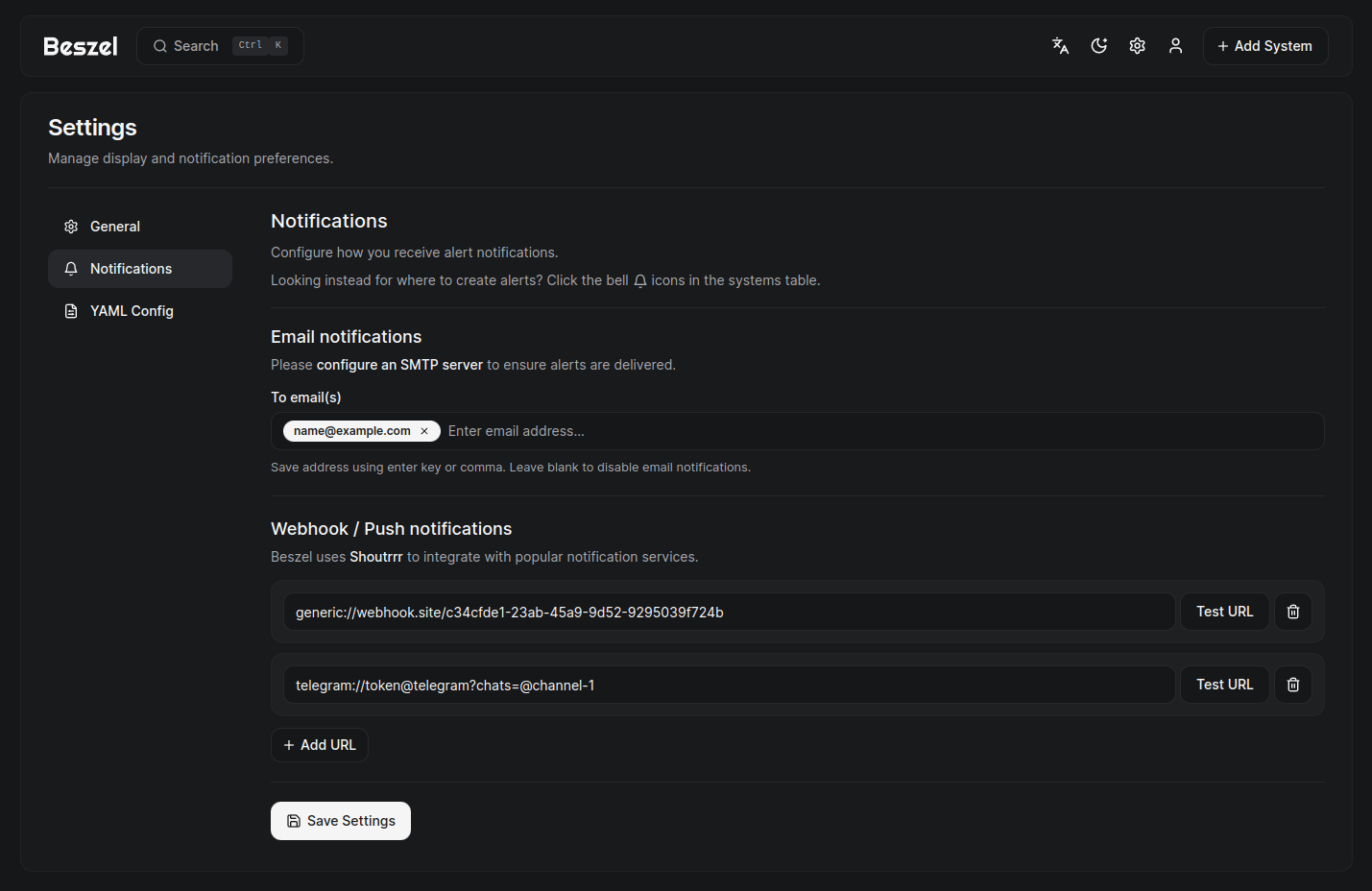
Supported metrics
- CPU usage - Host system and Docker / Podman containers.
- Memory usage - Host system and containers. Includes swap and ZFS ARC.
- Disk usage - Host system. Supports multiple partitions and devices.
- Disk I/O - Host system. Supports multiple partitions and devices.
- Network usage - Host system and containers.
- Load average - Host system.
- Temperature - Host system sensors.
- Fan speed - Host system sensors (Linux, via
/sys/class/hwmon). - GPU usage / power draw - Nvidia, AMD, and Intel.
- Battery charge - Host system and some peripherals.
- Containers - Status and metrics of all running Docker / Podman containers.
- S.M.A.R.T. - Host system disk health (includes eMMC wear/EOL and Linux mdraid array health via sysfs when available).
- ZFS - Pool capacity, usage, health, I/O throughput, scrub status, and per-dataset usage.
Help and discussion
Please search existing issues and discussions before opening a new one. I try my best to respond, but may not always have time to do so.
Bug reports and feature requests
Bug reports and feature requests can be posted on GitHub issues.
Support and general discussion
Support requests and general discussion can be posted on GitHub discussions or the community-run Matrix room: #beszel:matrix.org.
License
Beszel is licensed under the MIT License. See the LICENSE file for more details.